Politicians Make Poor Messiahs

I have noticed a trend in the last few Presidential elections. People seem to look at the leading candidate like he were some sort of messiah. No matter which side of the political spectrum your candidate is on, the man is the one who is going to fix all of the problems in the country. With his god-like status, he will be able to right all wrongs.

close up photo of man wearing black suit jacket doing thumbs up gesture

Photo by Lukas on Pexels.com

 The problem with this kind of thinking is that it just isn’t true. Our Presidents are human and can only do so much to alleviate the ills in the country. If they have a Congress that is willing to work with him, they may get something done. If not, the President is pretty much spinning his wheels during his time in office.

No matter who we elect, that person is human and a flawed individual. The media may or may not choose to prop the President up, but in the end, their flaws and mistakes become known. There is no hiding the fact; that even if they do their best, they will still make some pretty big mistakes.

Have we so left behind our belief in a Supreme Being that we are willing to assign god-like status to a man? Do we really think that a mere mortal can save us from ourselves and provide some sort of utopia here on the earth? There is nothing wrong with needing a Messiah as long as we choose one who is not fully human. Take Jesus, for instance; he is the ultimate God-Man. He was perfect, sinless and came to give his life for the likes of you and me. “For God so loved the world that He gave his only begotten Son, that whoever believes in him should not perish but have everlasting life.” John 3:16  Jesus is the only one who can take care of all of our needs and make our lives better.

Let’s quit looking at mere mortal men as messiahs. In spite of their best efforts, they are ALL flawed individuals. And let’s be done with looking at our Presidents and Presidential candidates like they can solve all of the ills of the world. From my vantage point, Politicians make poor Messiahs. How about from your vantage point? 

The Service for FREE SPEECH Will be Held Tomorrow

mourning-108781_1280

The service for FREE SPEECH will be held tomorrow in the Chapel on campus. Although the Chapel is a building held in disdain by many professors and students, it was the only place that would allow her service to be held. 

FREE SPEECH was born several millennia ago in Athens, Greece, at the Socratic School. There she was taught about forming cohesive and logical arguments and debating them with others. She spent her early years on Mars Hill, where for centuries men with different philosophical ideas shared their thoughts. Even the Apostle Paul went to Mars Hill to share his beliefs on the invisible God whom the Athenians worshipped. 

After several centuries, FREE SPEECH decided she wanted to travel the world. She tried to be admitted to many different countries, but she was not allowed in because of the danger she posed to the minds of their citizens. Almost all of the countries that let her in eventually treated her badly. She was imprisoned from time to time because various emperors, kings and dictators hated her ideas and wanted to silence her.

She found a friend in the United States in the 1700s and came to spend much of her time here. She was healthy and strong until the late 1980s when she contracted the virus Unpopularity. She thought this virus was benign, but it actually opened her immune system up to another more virulent virus called Political Correctness. That virus turned out to be malignant, and though it didn’t kill her immediately, she was in ill health after contracting it.

Due to her illness, she was rarely seen on campus after the turn of the 21st Century, and few professors or students knew she actually existed. She lived in a back room at the library, where she had been exiled by those in Academia. Because so few people came in to read and study, she was seen only rarely by a handful of students. Those who did know of her existence were afraid to talk about her for fear of reprisals.

She died quietly on campus one day when Political Correctness placed a small amount of Group Think in her water glass. No one noticed she had expired, as she had not been out of the library for well over a decade. When we heard of her demise, we sent in a Pathologist to confirm our suspicions. He was able to make a positive ID on her, and so we have decided to hold a memorial in her honor.

She is survived by her first cousins: INDEPENDENT THOUGHT and  CRITICAL THINKING. Other close relatives include: ROBUST DEBATE AND INTELLECTUAL INQUIRY. Her best friend LADY LIBERTY, will conduct the service, and her husband COURAGE, will speak on her behalf.

In lieu of flowers, those who knew FREE SPEECH believe her preference would be for each of you to go to a library and read the book of your choice (yes, even a Bible if you want to) and share the ideas you’ve learned with someone.

There will be plenty of parking behind the Chapel, as only a few on campus knew she existed at all, and will be attending. She will not be missed by many at the college, as she was always a thorn in the sides of her professors, and most students were afraid to associate with her. 

Hope to see you tomorrow!

Where Do You Spend Most of Your Time? The Troposphere, The Stratosphere or The Blogosphere?

Earth’s atmosphere is made up of several layers: the Troposphere, the Stratosphere, the Mesosphere, the Thermosphere, the Ionosphere, the Exosphere and the Magnetosphere. The layer closest to the Earth is called the Troposphere. It extends between 8 to 14.5 Kilometers above the Earth, depending on whose statistics you use. We live in the lower part of it, and planes fly up to the higher end of it. The Stratosphere is the layer above the Troposphere, and it extends to 50 Kilometers. Some planes may also fly in the lower part of it. The Mesosphere, extending to 85 Kilometers above the Earth, is where most of the meteors burn up. The Thermosphere, extending to 600 Kilometers above the Earth, is where the Satellites orbit the Earth. Above that is the Ionosphere extending up to 965 Kilometers, followed by the Exosphere, and the Magnetosphere. 

Unless you fly a lot, most of us spend our time down in the lower part of the Troposphere. Frequent flyers spend a lot of time in the upper part of it or in the lower part of the Stratosphere. It’s pretty easy to know where we spend our time physically, but the real question for all of us is: Where do we spend the most mental time? What holds most of our mental real estate?

three women standing near man holding smartphones

Photo by rawpixel.com on Pexels.com

A fellow blogger, Dawn from Dawn Running Strong, was talking about social media, and she shared that she wanted to be “fully present” with her family and friends. I read her post, and it really struck a chord with me. The day I post on my blog, I am checking my email more often to see if I need to respond to a comment. My mind is distracted by it, and many times, I am not “fully present” with those around me. I think that I am not the only person who struggles with it. Whether you are a blogger or not, it is easy to be distracted by our electronic devices. The picture above is an example of what I am talking about. The people are all standing around together, but they are not “together.” Each one is distracted by what they are looking at on their phones.

Whether it is our blogs, email, Facebook, the news, whatever, it is going to take intentionality if we want to be “fully present” with those around us. The hardest thing for most of us to do is to step away from our electronic devices and “live” right where we are. 

Studies have shown that our electronic devices can be very addictive. There seems to be an inverse relationship between our happiness vs. time spent on social media. Social media doesn’t necessarily mean “social” in the sense of being truly connected to others. It can actually make us unhappy if we start comparing our lives with others who are posting on Facebook or Instagram.

I enjoy being on the computer i.e., checking email, WordPress, Facebook and reading the news on a few sites. I just want to be able to compartmentalize them so that when I am with my family and friends, I can be “fully present.” How about you? How do you keep from being addicted to your social media and manage to be  “fully present” with those around you?

A Dog in the Tree

I was walking down a street the other day on one of my walks. My goal was to go to the end of the street and then turn around. As I neared my goal, suddenly to my left there was a dog in a tree. He was barking at me because I was on the sidewalk by his house. He continued to bark the entire time I walked by and then again as I returned.beagle-1815414_1280 photo by valtercirillo, courtesy of pixabay
First things first, how did the dog get up in the tree? I don’t know. There is a six-foot wooden fence on the side of his house, so I could not see how he got access. I’m guessing he stood on the top of his dog house and then climbed up the tree and stood in the crook of the tree as he performed his guard dog duties.

I wondered if he was going to jump over the fence and come at me. He was not tethered, and there was nothing stopping him from making the leap. He didn’t, though; he just continued to bark and be as annoying as possible. So the next time I want to walk that way, I have three choices: 1. Turn back before I meet my goal  2. Go to the other side of the street and finish my walk or  3. Walk by and listen to him harass me again.

The dog in the tree reminded me of the enemy of our souls. 1 Peter 5 says, “Be sober, be vigilant; because your adversary the devil walks about like a roaring lion, seeking whom he may devour. Resist him, steadfast in the faith, knowing that the same sufferings are experienced by your brotherhood in the world.”

Many times when we are near reaching a goal we have set, we experience a setback. Something (or someone) seems to be trying to stop us from reaching that goal. We have worked so hard, and at the very end, when it should be smooth sailing, we experience the most resistance. Why is that, and what should we do?

We first need to know that the enemy of our souls does not want us to meet our goals. He will do whatever he can to stop us. Sometimes, he is like a roaring lion i.e., he makes lots of noise to scare us away from our goal. What can we do when we experience resistance and setbacks?

Just like I had three choices when listening to the dog in the tree, I again have three choices: 1. I can give up and quit trying to reach my goal (Bad choice) 2. I can try to navigate another way forward to meet the goal or 3. I can move forward in spite of the noise and the resistance and just keep pressing on until I meet the goal. 

The noise and the resistance are trying to stop us. We must not let them, even if it means that it will take a while longer to meet the goal. We must press on and finish our goal. When we look back, we will see that the effort will have been worth it.  

We must realize that any time we embark on a worthwhile task, we might experience resistance. That does not mean we are on the wrong path; it may be an indicator that we are on the right path. We just need to keep moving forward. There will always be a barking dog in the tree; we just need to decide how to deal with it.

If You Had Your Choice: How Would You Prefer to Die?

If you had your choice, have you ever thought about how you would prefer to die? It may seem like a strange question, but it is one that is worth thinking about and answering. 

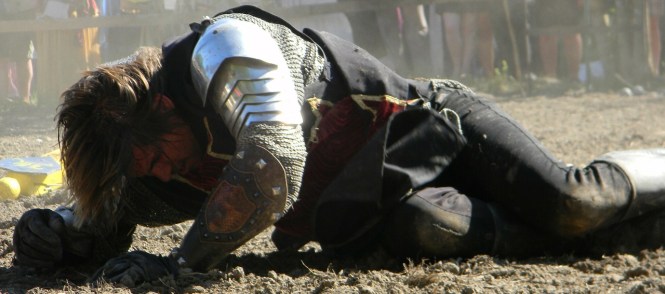
knight-321443_1280photo by jaymethunt courtesy of Pixabay

For me, the most noble way to die is defending or protecting others. Jesus said in John 15, “Greater love has no one than this, than to lay down one’s life for his friends.” So the soldier, the policeman, the fireman, the teacher, the crossing guard, whoever dies trying to protect others, they die the most heroic death. We honor them for the nobility of their sacrifice.

On the other end of the scale is the inglorious death. A life lived selfishly without thought for others, one who lives solely for oneself. We all know people who have passed, and no one missed them. They lived their lives in a totally self-gratifying way. Surely none of us would want to pass that way.

There are a lot of ways in the middle of the scale to die. You can die doing something you love. I have known of a couple of young men who have died climbing mountains. The only consolation their families had was, “They died doing what they loved.” At best, it is little consolation when you see a young life cut off while in its prime.

I don’t think any of us wants to die because of our own foolish choices. No one wants to go to a bar and die on the way home because they were drunk. We don’t want to die from an overdose of drugs. We don’t want to die from lung cancer because we chose to smoke our entire lives. We don’t want to die because we were texting while driving.

When we truly think about how we would want to die, it should give us motivation about how we should live. If we want to die in service to others, we should prepare ourselves physically, mentally and spiritually so that we have the mindset we need if we are ever in that situation. It should make us want to make right choices so that we can add to the lives of others for the short while we are here on this earth.

If we look at our lives and see that we are heading down a road of dissipation and addiction, we might want to take a day or two off from our drug of choice and really take stock of where we are. Do we need to get help to get sober or clean? There is no shame in admitting we need help. It is one of the bravest and most courageous things we can do.

Are we spending our entire lives solely trying to please ourselves? While it may feel good at the moment, in the end, our selfishness will add only a hollow ring to our lives. Remember the question put to the man at a funeral, “How much did he leave behind?” The answer was and always will be, “All of it.” We need to learn to share what we have with those less fortunate than ourselves. It will give our lives true meaning and purpose.

Let’s look at our lives and our lifestyles and see if we need to make any adjustments. After all, our lives are but a breath here, and we will soon be gone. So again I ask, “If you had your choice, how would you prefer to die?

Time Machine Moments 1.0

When you think back on your life, are there those moments when you would like to go back and give your younger self counsel? Would you like to help him or her navigate through circumstances a little bit better? I can think of many times in my life when I could have used good counsel, so whenever I write a post relating to this theme, it will be called Time Machine Moments. I will get in my Time Machine and go back and give my younger self counsel. Perhaps you will be able to relate to some of these moments as we travel back in time.time-2034990_1280photo by The Digital Artist, courtesy of Pixabay

I would take my Time Machine back to my first term in college. It was the summer session in Eugene, and all of the male students were in one dorm and the female students were in another dorm. I was walking down the hall and I heard someone crying. The door was open, and so I went into her room. She was a young, frightened foreign student from Vietnam. I didn’t know her name, but could see she obviously was in distress. Her English wasn’t good, but she was able to tell me she had gone to the eye doctor and needed glasses. She didn’t have the money to pay for them. I felt bad for her and told her I would see what I could do to help.

I went back to my room and began to think. I was seventeen myself and in a strange town where I didn’t know anyone. I was drawn into her problem by the emotion and felt motivated to do something, but what? I didn’t have much money as my father had placed me on a strict budget. So, I thought I needed to go with her to the eye doctor and ask them if they would consider giving her the glasses at a discount. I didn’t feel like I had any great social standing, so I thought that perhaps if I used an important last name, they might consider it. I chose the last name Kaiser because of the Kaiser Foundation. 

We went to the eye doctor, and I introduced myself to the receptionist. I told her the problem and asked if they would consider giving her the glasses at a reduced price. She went into the other room for quite a while and then came back and told us the doctor had approved the discount and the girl could have her glasses. She was ecstatic, and I was happy for her. I got no great satisfaction from the experience because I had lied about my name.  At that point, I didn’t feel I should go back to the office and tell them the truth, so I felt that there was nothing to do but live with it.

When would I step in and give my younger self counsel? I would show up when she came back to the dorm room after she encountered the student crying. If her plan was to go to the eye doctor, I would tell her to use her own name. It would be enough. I would tell her, “To thine own self be true,” and quote Polonius. If the eye doctor was going to give the student the glasses, it would make no difference what name she used. The generosity was up to the doctor, and she didn’t need to try to tip the scales by using a false name.

I would also tell her that she had another option. Although her father was out of town a lot, she could wait and get in contact with him. He was very generous, and he would probably just say to have the bill sent to him. If she would just step back from the urgency and the emotion of the moment, she could make better choices. I would tell her goodbye and step back into my time machine (Yes, it is a DeLorean!) until the next time she needed my counsel.vehicle-3250015_1280photo by Dtavres, courtesty of Pixabay

As I think about that experience, are there any takeaways for my life today? I think so. Many times, I am confronted by the needs of others, and there is a lot of emotion attached to those needs. I need to disassociate myself from the emotion and look at the situation objectively. Is there anything I can do or am supposed to do? If so, I should do it.

Is the situation beyond my ability to help? I would give myself the same advice I gave her: “Call your Father.” My earthly father has long since passed, but I have a Heavenly Father who is waiting and willing to answer my prayers. Jesus said, “Ask and it will be given to you.” I need to take the situation to my Heavenly Father and ask Him to intervene in the situation and provide the need. I can trust Him to work out the situation and provide what is needed. After all, He is never out of options and He knows the people who can help meet the need.

I also need to remember Polonius’s counsel. “This above all: To thine own self be true. And it must follow, as the night the day, Thou canst not then be false to anyone.” Will Shakespeare had it correct.

Bloggers Support Bloggers Award

bloggers-support-bloggers-button[1]

I want to thank Damaris Seijo for the nomination for this award. Damaris has an inspirational blog “The Believer’s Triumph” where she blogs about marriage and other relevant topics. Please visit her blog, you will enjoy it as much as I do. I appreciate the nomination for this award because this award is about one of the reasons we all blog…and that is to  learn from other bloggers and support them in their quest to make a difference in our world today.

The Rules:

1.  Thank the one who has tagged you for this challenge and link their blogsite.           2.  Add the official photo in your page.  3. List at least five bloggers you like.     (Suggestion: You can list up to 3 bloggers that you’ve known for a long time and up to 2 newbies or more. It’s up to you, though!)  4.  In 5 sentences or above, give a short description of why you love this blogger.  5. Tag at least 3 bloggers to do the challenge. 6. Put #bloggerssupportbloggers in the Tags section so whenever a blogger is looking for new blogs to read, it will be easier to find.

Blogs I like:

Each of these blogs adds something special to my life. They are insightful, full of information and inspirational! Check them out!

janeduquette.org                                                                                                                                 

Through Ink and Image

Review Tales by Jeryan Main

Sunshiny SA Site, Kavita Ranlal

Jonathan Caswell, By the Mighty Mumford

Knitting With Heart

Patrice Moolah, Good God Father

The Nominees:

Amy Blount, A New Life

Sundry Thoughts

The Domestic Church of Bosco

In Diane’s Kitchen

Kristi Ann’s Haven

GOD BLESS AND HAVE FUN! 💖💖💖 

Waiting to Get Fired!

I was working at a legal office when one day several Native Americans came in. They wanted to get their tribe reinstated as they had signed a treaty with the federal government decades before terminating their rights. They needed legislation drafted and prepared to take back to Congress in Washington D.C. They offered to have one of their members work at the office to help with the documentation for the legislation. 

I was asked to work with Bob. He was 6′ 3″ and weighed about 275 pounds. He was an imposing figure as he rode up on his motorcycle with his long black curly hair. He looked like someone you wouldn’t want to meet in a dark alley unless he were on your side. He was very intelligent and had a sense of humor to die for. They assigned us an office to work in.  Bob was supposed to obtain the legal documents i.e., treaties etc., and I was supposed to help write the tribal history and insert the legal documentation necessary to support the legislation.

Bob and I worked together for several months. We were about finished with our work, and the attorneys were almost ready to take everything back to Congress to introduce the legislation to reinstate the tribe. Everything was going well when some people showed up and wanted to talk to one of the attorneys about the case. 

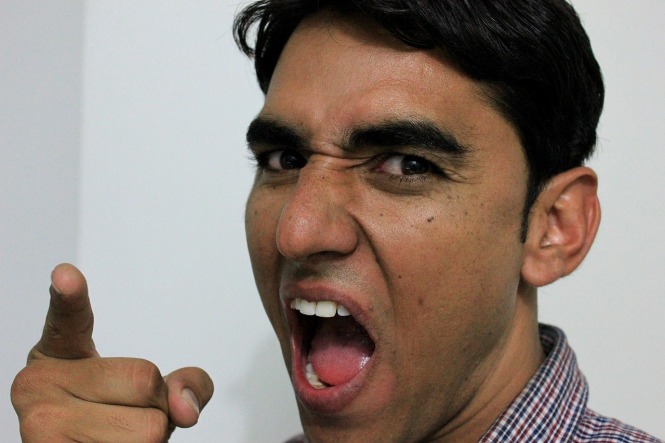
I was alone in the office when one of the attorneys came in. He looked at me and asked me to draft up several affidavits for the people to sign. He told me what the affidavits were supposed to say. I told him that that wasn’t right and that the affidavits would not be true. He looked at me and said, “Just do it!”angry-man-274175_1280

I was stunned to say the least. I knew the affidavits would not be true and that to draft them up and then witness them would be fraudulent. I thought about it for a few minutes and made a decision. I was not going to draft them up. Period. There were several reasons for this decision: 1. It would be ethically wrong. 2. It would be legally wrong. 3. It would destroy the credibility of the case as the affidavits would obviously be fraudulent. At that point, I was just waiting to get fired. This particular attorney had a bad temper and would brook no insubordination.

So, I did the only thing that made sense at the moment; I got a cup of coffee and started reading a book. After all, no use working on anything else as I was on my last few minutes for the firm. I was well into the first chapter of my book when the lead attorney for the case arrived back at the office. He saw me sitting there idly reading my book and came into the office. “What are you doing?” he asked. I said, “I’m waiting to get fired.” I then explained what had happened. He left the office and talked to the attorney who had given me orders to create the fraudulent affidavits. A while later, he came back and said, “You can get back to work,” which I assumed was code for “You’re not fired.”

I took a risk that day. I made a decision that was going to cost me my job. I was pregnant, and the firm paid for my health insurance. I lived in a small town, and there weren’t a lot of good jobs available. It would be hard to find another one if I had been fired from this job. Because of God’s grace, I did not have to pay a high price for my convictions.

There is always a cost if you follow your convictions. Jesus advised us in Luke 14 to count the cost when making a decision. Sometimes the cost isn’t too high, at other times it is. It is important to take the time to count the cost when making an important decision.

Bottom line for me: having a clear conscience, being able to sleep at night and look myself in the mirror in the morning is worth the cost. What about you? Have you had to pay a high price for your convictions? How did it turn out?   

Don’t Trust the Sherpa Completely

In the middle of the Cascade Range in Oregon, there is a group of mountains called The Three Sisters. Each one can be climbed, but the level of difficulty is different. The South Sister is supposed to be a fairly easy climb, the Middle Sister is a bit harder and the North Sister is a technical climb, meaning you will need mountain climbing equipment to make it to the top safely.

My husband met a man who took groups up the Middle Sister, and he wanted to go again as he had climbed it when he was a teenager. We met the man, and he told us what we would need to prepare for the climb. He said, “You won’t need an ice ax or crampons, just good boots. So okay, we were in. 

Several of us went, including my backpacking buddy, Ann. It took several hours, but most of us were able to make it to the top. A few couldn’t quite make it up because they began to have problems with the altitude. They would be picked up on the way down.woman-1209866_1280 

The view from the top of the mountain was magnificent. Looking north, we could see several mountains in the Cascades, including a few in Washington. Looking south, we had a different panoramic view extending into California. We could see hundreds of miles in any direction. It was spectacular to say the least. We stayed up there for a while, then decided to descend.

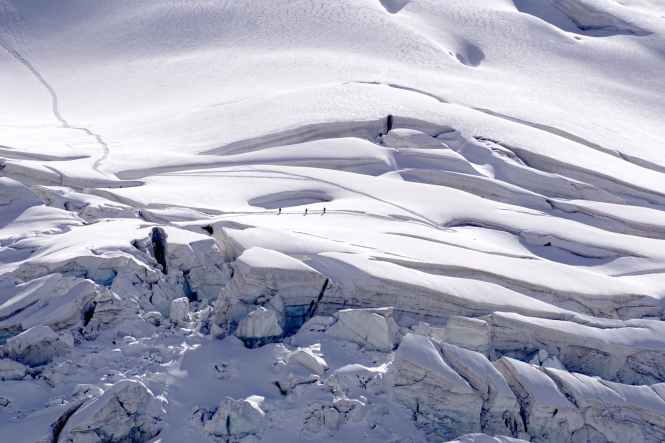
There was another man in the group who was also a leader. He was going to take everyone down the mountain, as the man we talked to wanted to glissade down one of the glaciers. My husband wanted to try it, and why Ann and I followed, I will never know. So off our Sherpa went. He took out his ice axe and went down. My husband followed without an ice axe and told us to be careful, as there was a crevasse down at the bottom. Ann and I held hands as we slid down the glacier on our bottoms. My husband waited at the bottom to keep us from going into the crevasse.  Slowly, ever so slowly, we went down. Then we carefully walked across the glacier and got on the main path that led down the mountain.

adventure alpine climb cold

Photo by Pixabay on Pexels.com

To say that Ann and I were angry is an understatement. We felt that it wasn’t safe to go down the glacier without an ice ax, and crampons would have been very helpful as we traversed the glacier. Should I have done more research before I went and not have totally relied on my Sherpa’s advice? Probably, yes. 

The leader who talked to us was right, of course. To go up and down the mountain, normally you would not need extra equipment. To do anything else, it would have been wise to have it. That experience taught me not to trust my Sherpa completely. I learned that whatever situation I am in, I must take responsibility for myself and do my own research and decide what will be needed for whatever undertaking I intend to proceed with. Then, and only then, can I make an informed decision and be prepared for wherever I am going and whatever I am doing.hiking-1582295_1280 photo by cssharker courtesy of pixabay

It is unwise to follow blindly and trust anyone completely. Humans are fallible and anyone can give us wrong or incomplete information. We each need to be responsible for ourselves and not trust our Sherpa completely. After all, you never know when you will be in a situation where you need an ice axe or crampons (or anything else for that matter)!

Forgiveness Comes Before Freedom in the Dictionary

Remember when you were in grade school and your teacher was teaching you how to use the dictionary? You worked on papers where you had to decide which word came first. You would receive your paper, and there would be rows of words, two at a time, and you had to circle the word that came before the other word in the dictionary.  Let’s say the two words were: forgiveness and freedom. Which word would you circle? Forgiveness, of course, always comes before freedom in the dictionary.

black and white book business close up

Photo by Pixabay on Pexels.com

Just as it is in the dictionary, so it is in life. Forgiveness always comes before freedom. Over the course of our lives, we receive many offenses from people, some large and others minute. We have two choices when we are in a position where someone has offended us: 1. We can either choose to hold on to the offense, or 2. We can forgive.

Forgiveness can be a very difficult thing to give in our lives, especially if someone has hurt us deeply. Our tendency is to want to hold on to the hurt and nurse it. After all, we have been wronged. The problem with this attitude is that the unforgiveness we carry does not necessarily harm the other person; it only harms us. We are a container, and when we hold on to an offense, it is like a toxic substance inside of us. The toxic substance does not do our bodies or our minds any good, only harm. 

When it comes right down to it, forgiveness is a choice. We must choose to forgive those who have done us wrong. When we do that, we become free of the offense. Is the process instantaneous?  We forgive and then we are free? Sometimes, but not usually. Forgiveness is a process. We choose to forgive, and then we begin to walk it out. The memory may come to mind again and again, but each time we say, “I choose to forgive that person; I am not going to carry this around with me anymore.”  Over and over, the process repeats, until at some point, the memory fades and that offense no longer has power over us.

You will say to me, “But you don’t understand what so and so has done to me.” You’re right, I don’t understand, but the process is the same. Jesus told us a great story about this principle. In Matthew 18, he tells us about a servant who owed a king a great deal of money; by today’s standards, it would be several million dollars. The servant could not pay the debt, and the king commanded that the man, his wife, children and all he had be sold to pay the debt. The servant then fell down and begged him to forgive the debt. The king relented and forgave the servant the entire debt.

The servant then went out from the king and found someone who owed him several thousand dollars.  He took the man by the throat and demanded that the man pay him what he owed him. The debtor begged the man to have compassion on him, and he would pay him what was owed, but the servant would not show mercy. He had the man thrown into prison. Soon, it was reported to the king what the servant had done to his debtor. The king then called the servant and demanded to know why he had treated the other man so harshly, seeing that he had received mercy. He then threw the man into prison until all of his debt was paid. The story ends with this admonition from Jesus, “So My heavenly Father also will do to you if each of you, from his heart, does not forgive his brother his trespasses.

The point of this story is that we all stand before God owing a great debt; that debt being our sins and trespasses. If we want God’s forgiveness, we must be willing to forgive those who have sinned or trespassed against us. It is a spiritual law of the universe. If we want it, we have to be willing to give it.

You will say to me, “But, you still don’t understand what so and so did to me.” You’re right, I don’t, but God does. 

In order to do this, we also must understand what forgiveness is not:

1. Forgiveness IS NOT saying that what the person did was not wrong. It was wrong and nothing will change it.

2. Forgiveness IS NOT saying that the person won’t have to make restitution for what they did to you. They still  may owe a debt to society and may need to go through the judicial system. 

Forgiveness IS you releasing them from the wrong they committed against you. They are still responsible before God and society for what they did. You no longer have to live in a prison of hate or despair over their actions. You can be free from them.

You see, in life, just as it is in the dictionary, forgiveness always comes before freedom.